 Northern Ireland
City guide · Northern Ireland
Belfast
About Belfast
Belfast is the capital of Northern Ireland, a compact city on the River Lagan that grew on linen, rope-making and shipbuilding. The RMS Titanic was built in its Harland & Wolff shipyard and launched in 1911, and the city today pairs that industrial heritage with a friendly, lively atmosphere.
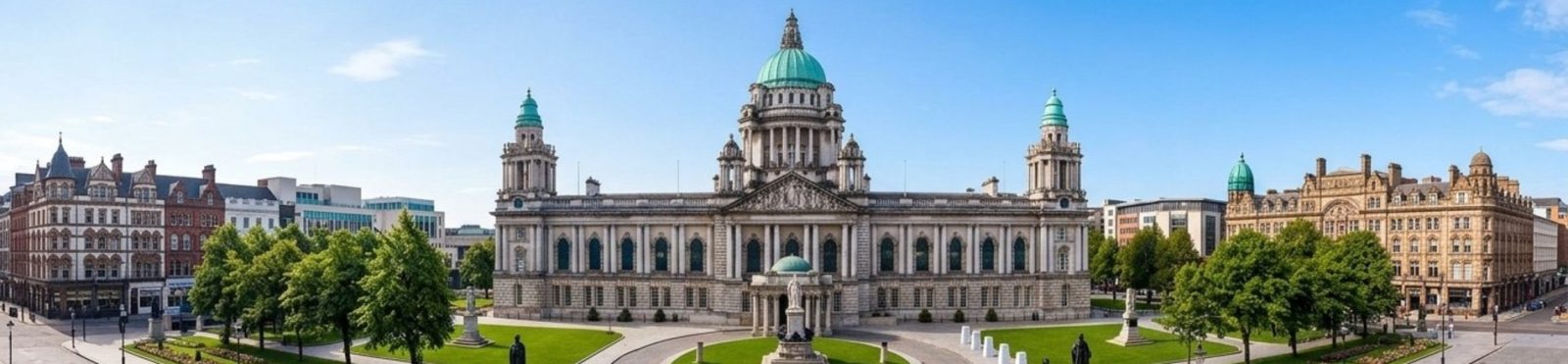
Key sights include Titanic Belfast in the Titanic Quarter, the domed City Hall, the Cathedral Quarter with its pubs and street art, Queen's University and the Botanic Gardens, and St George's Market at weekends. Many visitors take a guided taxi tour of the political murals of West Belfast, and Crumlin Road Gaol offers tours of a former Victorian prison.
Two to three nights work well. The Causeway Coastal Route leads to the UNESCO-listed Giant's Causeway, about an hour and a half by road, passing the Carrick-a-Rede rope bridge and the Dark Hedges. Dublin is about two hours away by train or coach, so Belfast combines easily with a tour of Ireland.
Northern Ireland provided many filming locations for the television series Game of Thrones, which adds interest for younger travellers and families on the coastal day trip.
Practical Information
Useful to know before your group arrives in Belfast.
Loading typical weather…
Typical weather is not available right now. Please try again later.
| High °C |
|---|
| Low °C |
| Rainy days |
Belfast has a mild, damp maritime climate with few extremes; rain is possible on any day of the year.
- Spring (March–May): highs rising from about 10°C to 15°C, with sunny spells and showers.
- Summer (June–August): highs around 17–19°C and very long daylight hours.
- Autumn (September–November): highs falling from about 16°C to 9°C, increasingly wet and windy.
- Winter (December–February): highs around 7–8°C, short days, with frost possible but snow uncommon.
May to September is the best time to visit. Pack layers, a waterproof jacket and comfortable shoes, especially for the exposed Causeway Coast.
- Arriving: George Best Belfast City Airport is about 10 minutes from the centre by taxi or bus. Belfast International Airport is about 30 minutes away by road, linked by an express airport bus. Many long-haul travellers fly into Dublin Airport, about two hours away by coach.
- Getting around: The centre is walkable. Translink runs the Metro buses and the Glider rapid-transit service; Glider tickets are bought from machines at the stops before boarding.
- By train: The Enterprise train connects Belfast and Dublin in a little over two hours.
- Groups: The Causeway Coast is best covered as a full-day coach excursion, as public transport along the coast is limited.
An eSIM or data plan bought before travel usually costs Indian travellers much less than an Indian international roaming pack. Northern Ireland is part of the UK, which is not in the EU, so an EU plan may not cover it; check that your eSIM includes the UK. Local prepaid SIM cards are sold at airports and in shops; a passport is needed at purchase.
Free Wi-Fi is common in hotels and cafés. The UK uses 230 V with Type G sockets; Indian Type D plugs do not fit, so a universal adapter is needed.
Belfast has a reasonable number of Indian restaurants and takeaways, along with a few South Asian grocery shops, though the choice is smaller than in larger UK cities. Vegetarian dishes are easy to find, and Jain meals should be requested in advance through the DMC. Halal food is available but less common, so it is best arranged ahead for groups.
Local vegetarian-friendly foods include soda bread and potato bread, champ (mashed potato with spring onions) and vegetable soups; a vegetarian version of the Ulster fry breakfast is often available on request. Supermarket chains such as Tesco, Sainsbury's, Lidl and Spar are convenient for snacks, fruit and milk.