 Ireland
City guide · Ireland
Dublin
About Dublin
Dublin, the capital of Ireland, grew from a Viking settlement on the River Liffey into an elegant Georgian city. It is known for its literary heritage, its friendly atmosphere, its pubs and live music, and its compact, walkable centre.
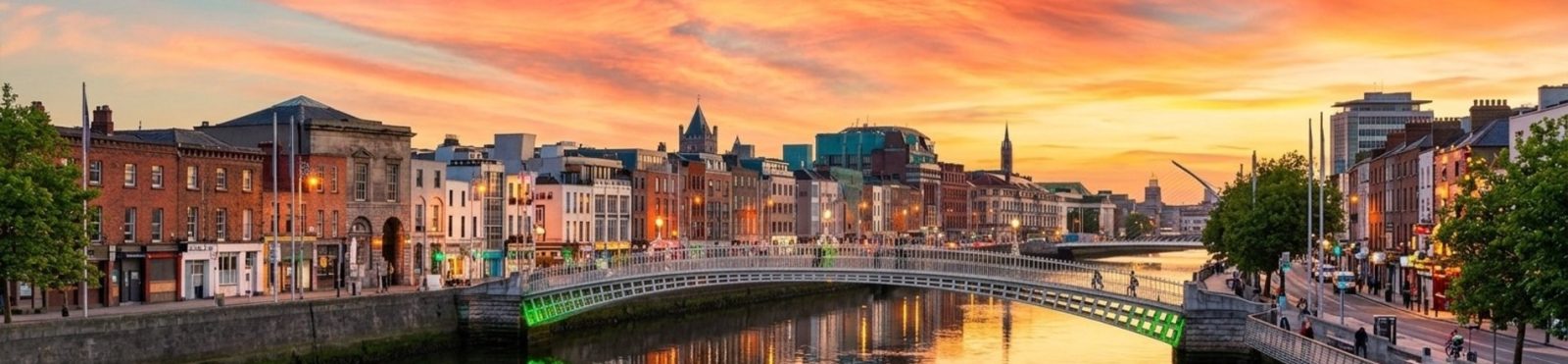
Key sights include Trinity College and the Book of Kells, Dublin Castle, St Patrick's and Christ Church cathedrals, the Guinness Storehouse, Kilmainham Gaol, the Ha'penny Bridge and the lively Temple Bar area. Grafton Street is the main shopping street, leading to St Stephen's Green, and Phoenix Park is one of the largest enclosed city parks in Europe.
Two to three nights suits most itineraries. The fishing village of Howth is about 30 minutes away by DART coastal train, and Glendalough and the Wicklow Mountains are about an hour by road. Belfast in Northern Ireland is about two hours by train, while the Cliffs of Moher make a long full-day trip from Dublin.
Dublin is a popular base for student and educational groups, with its universities and its free national museums and galleries.
Practical Information
Useful to know before your group arrives in Dublin.
Loading typical weather…
Typical weather is not available right now. Please try again later.
| High °C |
|---|
| Low °C |
| Rainy days |
Dublin has a mild, damp climate with no great extremes; rain is possible in any season.
- Spring (March–May): cool and fresh, highs from around 10°C to 15°C.
- Summer (June–August): mild, highs around 18–20°C, with long evenings.
- Autumn (September–November): cooling from around 17°C to 10°C, with more wind and rain.
- Winter (December–February): chilly and damp, highs around 8–9°C, snow is rare.
May to September offers the best weather. Pack layers, a rain jacket or umbrella and comfortable walking shoes at any time of year.
- Arriving: Dublin Airport is about 10 km north of the city. There is no rail link; express coaches and Dublin Bus services reach the centre in about 30–45 minutes, and a taxi takes a similar time depending on traffic.
- Getting around: the centre is walkable. Dublin Bus covers the city, the Luas tram has two lines (Red and Green), and the DART train runs along the coast to Howth and Bray.
- Tickets: the rechargeable Leap Card gives cheaper fares than single tickets on buses, Luas and DART; visitor versions for several days are available.
- Groups: coaches can drop near main sights, but city-centre traffic is heavy, so allow extra time and walk between nearby attractions.
Mobile data: for Indian travellers, an eSIM or a European data plan bought before departure usually costs much less than Indian international roaming packs. Local prepaid SIMs are sold at the airport and in phone shops; a passport is needed at purchase. Ireland is in the EU, so an EU/EEA SIM or eSIM works here. Northern Ireland is part of the UK, so for a Belfast trip check that the plan includes the UK.
Wi-Fi: free Wi-Fi is common in hotels, cafés and pubs.
Power: 230 V with Type G (three-pin) sockets. Indian Type D plugs do not fit, so bring a universal adapter.
Dublin has a wide choice of Indian, Pakistani and Bangladeshi restaurants and takeaways across the city, plus Indian grocery shops. Halal food is available, and vegetarian options are easy to find. Jain meals are best requested in advance through the DMC or the restaurant.
Irish dishes that suit vegetarians include colcannon (mashed potato with cabbage or kale and butter), boxty (potato pancakes) and fresh soda bread; check that soups are made with vegetable stock. Tesco, Dunnes Stores, SuperValu, Lidl and Aldi supermarkets are convenient for snacks, fruit, milk and bread.