 Belgium
City guide · Belgium
Antwerp
About Antwerp
Antwerp, in the Flemish region of Belgium, is one of Europe's largest ports and has long been a world centre of the diamond trade. It was home to the painter Peter Paul Rubens, and today it is also known for fashion, design and lively shopping streets.
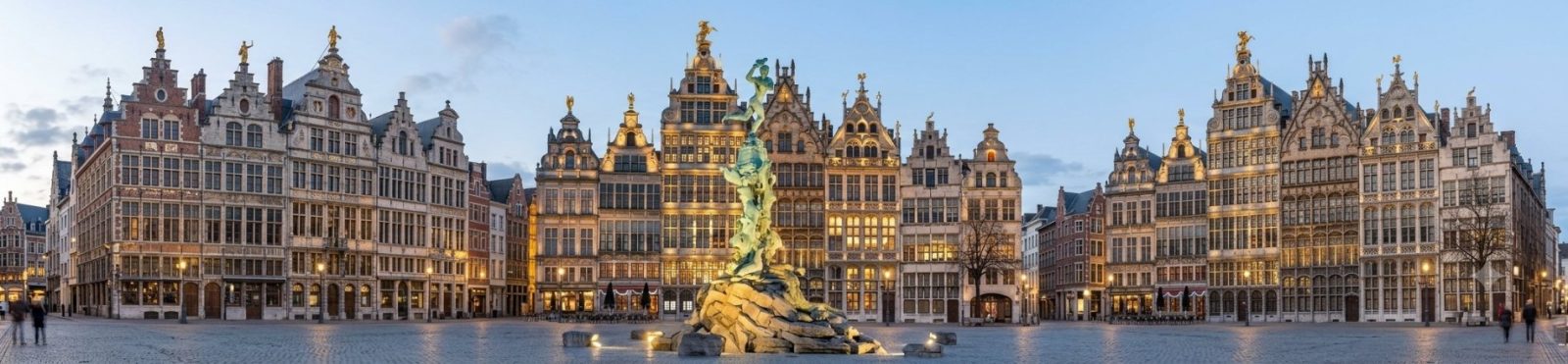
Highlights include Antwerpen-Centraal, one of the most impressive railway stations in Europe, the Cathedral of Our Lady with its Rubens paintings, the Grote Markt with its Town Hall and Brabo Fountain, the riverside Het Steen castle and the MAS museum with its rooftop views. The Meir is the main shopping street.
One to two nights suits most itineraries. Brussels is about 45 minutes away by train, Ghent under an hour and Bruges around one and a half hours, while Rotterdam in the Netherlands can be reached in under an hour by train.
The diamond quarter beside the central station has a long-established Indian community, many of them Gujarati and Jain families in the diamond trade, and a Jain temple stands in the suburb of Wilrijk.
Practical Information
Useful to know before your group arrives in Antwerp.
Loading typical weather…
Typical weather is not available right now. Please try again later.
| High °C |
|---|
| Low °C |
| Rainy days |
Antwerp has a mild maritime climate, with rain possible in every season and few extremes.
- Spring (March–May): Cool to mild, with highs from about 10°C to 18°C.
- Summer (June–August): Comfortable, with highs around 22–24°C.
- Autumn (September–November): Mild at first, becoming cool, grey and wetter.
- Winter (December–February): Cold and damp, with highs around 5–7°C and occasional frost.
May to September is the best time to visit. Pack layers, a rain jacket or umbrella and comfortable walking shoes.
- Arriving: Brussels Airport is the main gateway, with direct trains to Antwerpen-Centraal in around 35–45 minutes. Antwerp also has a small regional airport with limited flights.
- Getting around: The centre is walkable, and De Lijn trams, including underground premetro sections, and buses cover the wider city.
- By rail: Antwerpen-Centraal has frequent trains to Brussels, Ghent and Bruges, and international services to the Netherlands.
- Groups: Antwerp has a low-emission zone, so coach operators should check that their vehicle meets the rules; the old town streets are narrow, so coaches usually drop groups at its edge.
Mobile data: For Indian travellers, an eSIM or European data plan bought before travel usually costs much less than Indian international roaming packs. Prepaid SIMs are sold in phone shops and some newsagents; a passport is needed at purchase. A Belgian or other EU SIM or eSIM works across other EU/EEA countries, including the Netherlands, under EU roaming rules.
Wi-Fi: Free Wi-Fi is common in hotels and cafés.
Power: 230 V with Type C/E sockets. Indian Type D plugs do not fit, so a universal adapter is needed.
Thanks to its long-established Indian community, Antwerp is one of the easier Belgian cities for Indian food, with Indian vegetarian restaurants and grocery shops in the area around the central station and diamond quarter. Jain meals are more familiar here than in most of Europe, but should still be requested in advance through the DMC or the restaurant. Halal food is widely available at Turkish, Moroccan and Middle Eastern restaurants.
Belgian foods that suit vegetarians include waffles, stoemp (mashed potato with vegetables) and fries, though it is worth asking whether these are cooked in vegetable oil. Delhaize, Carrefour, Colruyt and Lidl supermarkets are good for snacks, fruit, milk and bread.
Tailor-made for your group
Planning Antwerp for Your Group?
We don't list ready-made sightseeing or itineraries for Antwerp yet, but our team can plan it for you: hotels, guided sightseeing, transfers and onward connections. Share your dates and group size and we'll send a proposal built around Antwerp.
Itineraries in Belgium
None of our set itineraries includes an overnight stay in Antwerp yet. These Belgium itineraries can be adapted to include it.