 Belgium
City guide · Belgium
Bruges
About Bruges
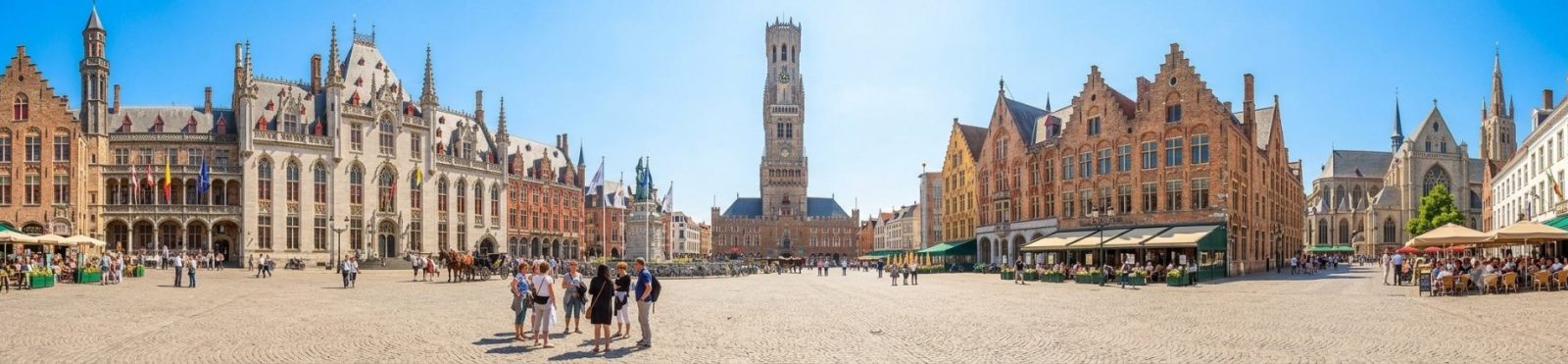
Bruges, in the Flemish region of north-west Belgium, was one of the richest trading cities of medieval Europe. Its canals, cobbled lanes and well-preserved brick buildings have made its historic centre a UNESCO World Heritage Site and one of the most photographed towns in the country.
The Markt square with its tall Belfry and the neighbouring Burg square with the Basilica of the Holy Blood form the heart of the town. A canal boat tour is the classic way to see Bruges, and the peaceful Beguinage, the Minnewater lake and the Groeninge Museum of Flemish art are close by. Chocolate shops and lace shops line the central streets.
Bruges suits a day visit or one night. Brussels is about an hour away by train and Ghent around 25 minutes, so the three combine easily. The Belgian coast is a short drive or train ride away.
The compact, car-free feel of the centre makes Bruges relaxed for families and older travellers, and chocolate tastings are popular with groups.
Practical Information
Useful to know before your group arrives in Bruges.
Loading typical weather…
Typical weather is not available right now. Please try again later.
| High °C |
|---|
| Low °C |
| Rainy days |
Bruges has a mild maritime climate influenced by the nearby North Sea, with rain possible throughout the year.
- Spring (March–May): Cool to mild, with highs from about 10°C to 17°C and breezy days.
- Summer (June–August): Comfortable, with highs around 21–23°C.
- Autumn (September–November): Mild early on, becoming cool, windy and wetter.
- Winter (December–February): Cold and damp, with highs around 5–7°C.
April to September is the best time to visit, though summer weekends are busy. Pack a rain jacket, layers for the wind and comfortable shoes for cobblestones.
- Arriving: Bruges has no airport of its own. Brussels Airport is the usual gateway, with trains to Bruges taking around one and a half hours, sometimes with a change in Brussels or Ghent.
- Getting around: The historic centre is small and best explored on foot. The railway station is about 15–20 minutes' walk from the Markt, and local De Lijn buses run between the station and the centre.
- By rail: Frequent trains link Bruges with Ghent, Brussels and Antwerp.
- Groups: Coaches are not allowed into the historic centre and normally drop groups at the coach area near the railway station, from where guests walk in.
Mobile data: For Indian travellers, an eSIM or European data plan bought before travel usually costs much less than Indian international roaming packs. Prepaid SIMs are sold in phone shops and some newsagents; a passport is needed at purchase. A Belgian or other EU SIM or eSIM works across other EU/EEA countries under EU roaming rules.
Wi-Fi: Free Wi-Fi is common in hotels and cafés.
Power: 230 V with Type C/E sockets. Indian Type D plugs do not fit, so bring a universal adapter.
Bruges has only a few Indian restaurants, so choice is limited; Ghent and Brussels, both a short train ride away, offer far more. Most restaurants can offer a vegetarian dish, while Jain meals should be requested well in advance through the DMC or the restaurant. Halal options are limited in the historic centre but can be found at some Turkish and Middle Eastern eateries.
Belgian foods that suit vegetarians include waffles, fries (ask whether they are cooked in vegetable oil, as some shops use beef fat) and stoemp, a mash of potato and vegetables. Delhaize, Carrefour and Lidl supermarkets are useful for snacks, fruit, milk and bread.
Itineraries in Belgium
None of our set itineraries includes an overnight stay in Bruges yet. These Belgium itineraries can be adapted to include it, or we can build one around Bruges for your group.