 Sweden
City guide · Sweden
Stockholm
About Stockholm
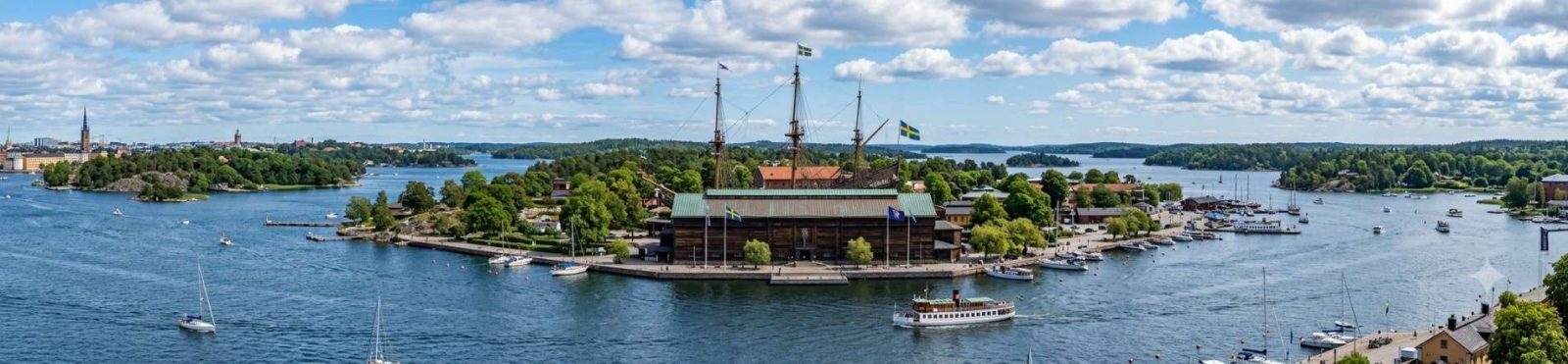
Stockholm, the capital of Sweden, is spread across fourteen islands where Lake Mälaren meets the Baltic Sea. Founded in the 13th century, it combines a well-preserved medieval core with green parks, clean water and Scandinavian design.
Most visits begin in Gamla Stan, the old town, with the Royal Palace and its narrow lanes. On the island of Djurgården are the Vasa Museum, built around a 17th-century warship, the open-air museum Skansen and ABBA The Museum. City Hall, where the Nobel Prize banquet is held, and a boat trip through the archipelago round off a first visit.
Two to three nights suit most itineraries. The university town of Uppsala is about 40 minutes away by train, and Drottningholm Palace can be reached by boat in summer. Stockholm pairs well with Copenhagen (about five hours by train) and with Helsinki or Tallinn by overnight ferry.
The long, light evenings of June and July are ideal for groups, and many metro stations are decorated with artwork, which makes even short journeys interesting.
Practical Information
Useful to know before your group arrives in Stockholm.
Loading typical weather…
Typical weather is not available right now. Please try again later.
| High °C |
|---|
| Low °C |
| Rainy days |
Stockholm has four distinct seasons, with long summer days and short, dark winter days.
- Summer (June–August): mild and bright, with highs around 20–23°C.
- Autumn (September–November): cooling from about 15°C to 5°C, often grey and damp.
- Winter (December–February): cold, with highs around 0°C, lows of about −3 to −5°C and little daylight.
- Spring (March–May): highs climbing from about 3°C to 16°C.
May to September is the best time to visit. Pack layers and a rain jacket in summer; in winter bring a warm coat, gloves, a hat and thermals.
- Arriving: Stockholm Arlanda Airport is about 40 km north of the city. The Arlanda Express train reaches Stockholm Central Station in about 20 minutes; airport coaches take around 45 minutes and commuter trains also run.
- Getting around: the SL network covers the metro (tunnelbana), buses, trams, commuter trains and some ferries. Tickets are sold through the SL app and at stations, and passes for 24 hours, 72 hours or 7 days suit sightseeing.
- On foot and by boat: Gamla Stan and the central districts are walkable, and boats link the centre with Djurgården.
- Payments: cards are accepted almost everywhere and some places do not take cash.
For travellers from India, an eSIM or a European data plan bought before departure usually costs much less than Indian international roaming packs. Local prepaid SIM cards are sold at the airport and in phone shops; a passport is needed to buy one. An EU SIM or eSIM also works in other EU/EEA countries under EU roaming rules.
Free Wi-Fi is common in hotels and cafés. The power supply is 230 V with Type C/F sockets; Indian Type D plugs do not fit, so bring a universal adapter.
Stockholm has a fair number of Indian restaurants, mostly in the central districts, and vegetarian and vegan options are widespread in a city that takes plant-based food seriously. Halal food is available, particularly in Middle Eastern restaurants. Jain meals should be requested in advance through the DMC or the restaurant.
Local treats that suit vegetarians include kanelbullar (cinnamon buns) with coffee at fika time, Swedish pancakes with lingonberry jam (made with egg) and crispbread with cheese. For snacks, fruit, milk and bread, look for ICA, Coop, Hemköp, Willys and Lidl.