 Germany
City guide · Germany
Munich
About Munich
Munich, the capital of Bavaria in southern Germany, combines royal palaces, beer-hall tradition and a prosperous modern economy. Founded in the 12th century, it was for centuries the seat of the Wittelsbach rulers of Bavaria, and it sits within sight of the Alps on clear days.
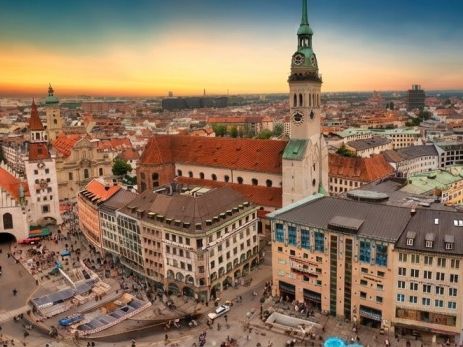
Highlights include Marienplatz and the New Town Hall with its Glockenspiel, the twin-towered Frauenkirche, the Viktualienmarkt food market, the Residenz palace, the English Garden, Nymphenburg Palace, the Olympic Park, the Deutsches Museum and BMW Welt.
Two to three nights suit most itineraries. Neuschwanstein Castle is about two hours away by road, Salzburg about an hour and a half by train, and Garmisch-Partenkirchen and the Zugspitze, Germany's highest mountain, about an hour and a half. Munich connects naturally with Innsbruck, the Austrian Tyrol and Switzerland.
Oktoberfest, which runs from late September into early October, draws huge crowds, so hotels should be booked well in advance; BMW Welt is popular with families and car enthusiasts.
Practical Information
Useful to know before your group arrives in Munich.
Loading typical weather…
Typical weather is not available right now. Please try again later.
| High °C |
|---|
| Low °C |
| Rainy days |
Munich has a continental climate influenced by the nearby Alps, with warm summers and cold winters.
- Spring (March–May): changeable, with highs rising to around 18–19°C by May.
- Summer (June–August): warm, with highs around 23–25°C and frequent afternoon thunderstorms.
- Autumn (September–November): pleasant in September, then cool and often foggy.
- Winter (December–February): cold, with highs around 2–4°C, frost and regular snow.
May to September is best for sightseeing and Alpine excursions. Pack layers, a rain jacket and comfortable shoes, plus warm clothing for mountain trips at any time of year.
- Arriving: Munich Airport is linked to the city centre by S-Bahn lines S1 and S8 in about 40 minutes; a taxi takes a similar time depending on traffic.
- Getting around: the U-Bahn, S-Bahn, trams and buses cover the city, and the old town is easy to explore on foot.
- Tickets: paper tickets must be validated before travel; day tickets and group day tickets are good value for sightseeing.
- Groups: the old town between Karlsplatz (Stachus) and Marienplatz is a pedestrian zone, so coaches drop groups at its edge.
Mobile data: for Indian travellers, an eSIM or a European data plan bought before travel usually costs much less than Indian international roaming packs. Local prepaid SIMs are sold at the airport and in phone shops (passport needed for registration). Germany is in the EU, so an EU plan also works in Austria and other EU/EEA countries, but Switzerland is not in the EU, so check that the eSIM includes it.
Wi-Fi: free Wi-Fi is common in hotels and cafés.
Power: 230 V with Type C/F sockets. Indian Type D plugs do not fit, so carry a universal adapter.
Munich has a good choice of Indian restaurants, and halal food is widely available at Turkish and Middle Eastern places. Bavarian cooking is meat-heavy, but vegetarian dishes are offered almost everywhere, and Jain meals should be requested in advance through the DMC or restaurant.
Bavarian dishes that suit vegetarians include large Brezn (pretzels), Käsespätzle (cheese noodles), Semmelknödel (bread dumplings, often with mushroom sauce) and Kaiserschmarrn (shredded pancake with fruit compote). Supermarkets such as REWE, Edeka, Lidl and Aldi are handy for snacks, fruit, milk and bread; most close on Sundays.